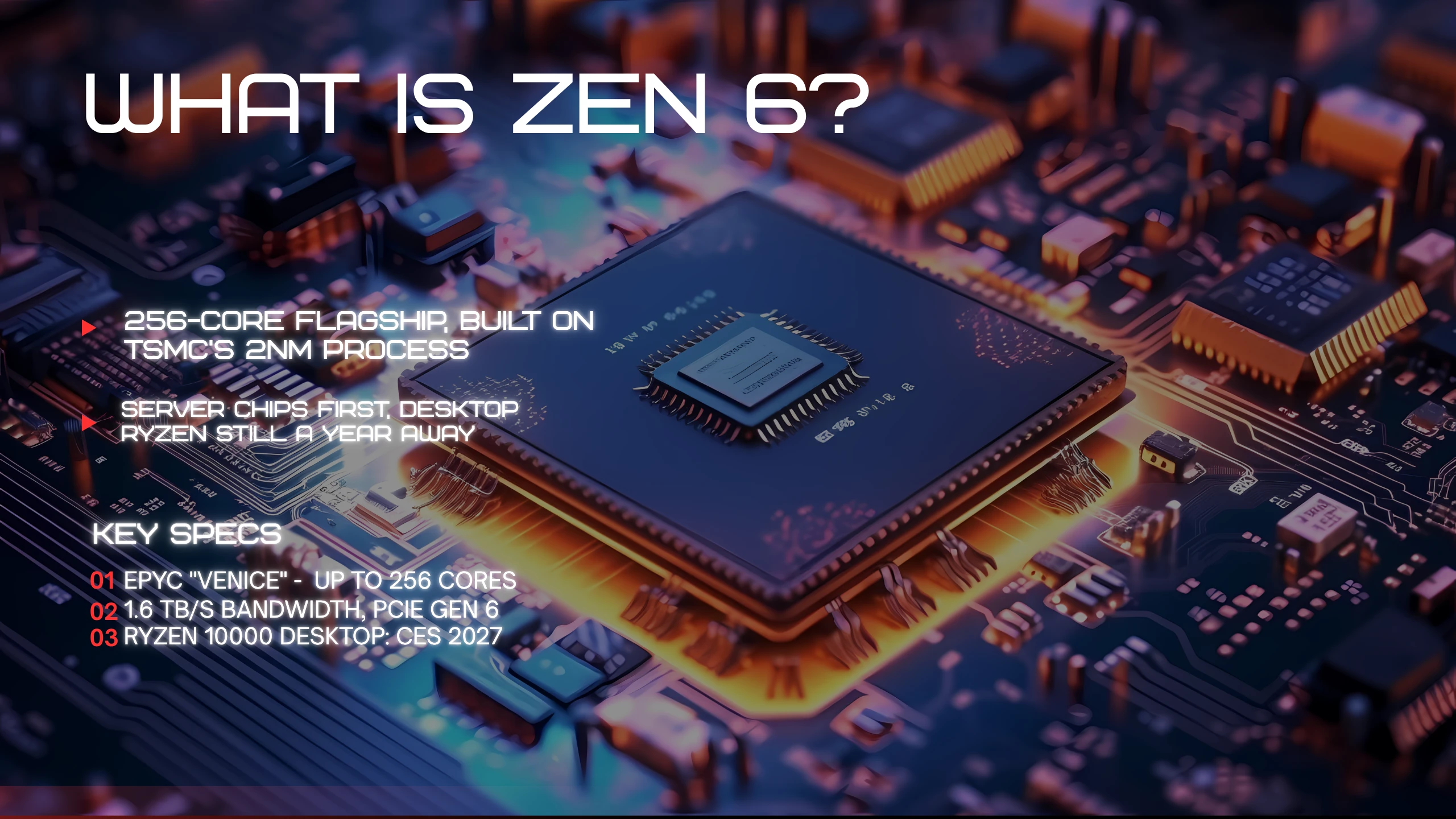
AMD will officially unveil Zen 6, its sixth-generation architecture, at its Advancing AI 2026 event in San Francisco on July 22-23. But the “can’t buy it” part of the title is accurate: the first chip to be announced is a server processor, not a Ryzen. CTO Mark Papermaster confirmed the date weeks earlier at the RAISE Summit in Paris: “We launched Zen back in 2017, and now we’re on our sixth generation. At our Advancing AI event on July 22nd and 23rd, we’re rolling out this new generation.”
Server First, Desktop Later
The first product to come out of Zen 6 won’t be a Ryzen chip. Sixth-generation EPYC server processors, codenamed “Venice,” will be at the center of this event.
Here’s what’s expected on the spec sheet: the flagship model is expected to scale up to 256 cores, a 33% increase over the current 192-core “Turin” lineup. AMD is claiming a 70%+ improvement in performance and efficiency over Zen 5. The chip will be built on TSMC’s 2nm (N2) process, making it the first HPC chip produced on that node. A new SP7 socket, 16-channel memory support, and 1.6 TB/s of bandwidth are expected, along with PCIe Gen 6 support for faster CPU-to-GPU communication.
Venice will form the CPU side of AMD’s new Helios rack-scale AI platform, working alongside AMD Instinct MI455 accelerators and Pensando networking hardware. The package is positioned as a direct competitor to Nvidia’s Blackwell Ultra and Rubin NVL72 systems.
The event is expected to include a keynote from Lisa Su on July 23, over 100 technical sessions, and an expo floor featuring companies including Dell, Google, Lenovo, and Nutanix.
A Different Timeline for Desktop Users
The consumer side of Zen 6, the Ryzen 10000 series (codenamed “Olympic Ridge”), is on a separate timeline. According to leakers Kepler_L2 and HXL, generally considered reliable sources on the Chiphell forum, desktop Zen 6 is expected to be unveiled at Computex 2026, with retail availability sliding into CES 2027. That puts it roughly a year behind the server chips.
Rumored desktop specs include clock speeds above 6.5GHz, AMD breaking its traditional 8-core-per-chiplet limit with new 12-core CCDs, and configurations ranging from 6 to 24 cores. AM5 socket support is expected to continue, at least via a BIOS update. None of this has been officially confirmed by AMD.
Bottom Line
AMD’s July 22-23 announcement is an important moment for clarifying the company’s data center and AI infrastructure ambitions. But for desktop users, the more relevant Ryzen 10000 series is still largely in rumor territory, and points to close to a year of waiting. We’ll update this post with confirmed details once the event wraps.


 Veysel Okatan