The tech world is currently obsessed with a polarizing question: “Is coding dead?” In this post, I wanted to explain to you why I believe it hasn’t died, but rather changed dimensions. So, what is the thing that changed? Just as the only thing that doesn’t change is change itself, what has changed at this point is that we are no longer the ones writing “Hello World” codes.
However, there is still a point that remains standing and requires humans, which is producing strategy, producing value, and producing ideas. At this very point, there is a point (or points) that are still unsolved, where perhaps we reach our technological secrets. I want to examine one of these with you through an example.
1% Data Loss: The Hidden Trillion-Dollar Opportunity
Our current computing systems are trapped in a binary cage while trying to represent the infinite complexity between 0 and 1. When a processor processes a repeating value like $0.3333…$, it eventually rounds this number to protect the memory.
This technical compromise leads to what I call “1% Data Loss.” Although it seems insignificant for a single calculation, this loss grows exponentially in billions of operations. I believe that NP-Complete problems, one of the world’s deepest unsolved problems, cannot be solved precisely because of the answers hidden within this discarded 1% of data.
Breaking the Binary System: Storing Data in a Probability Cube
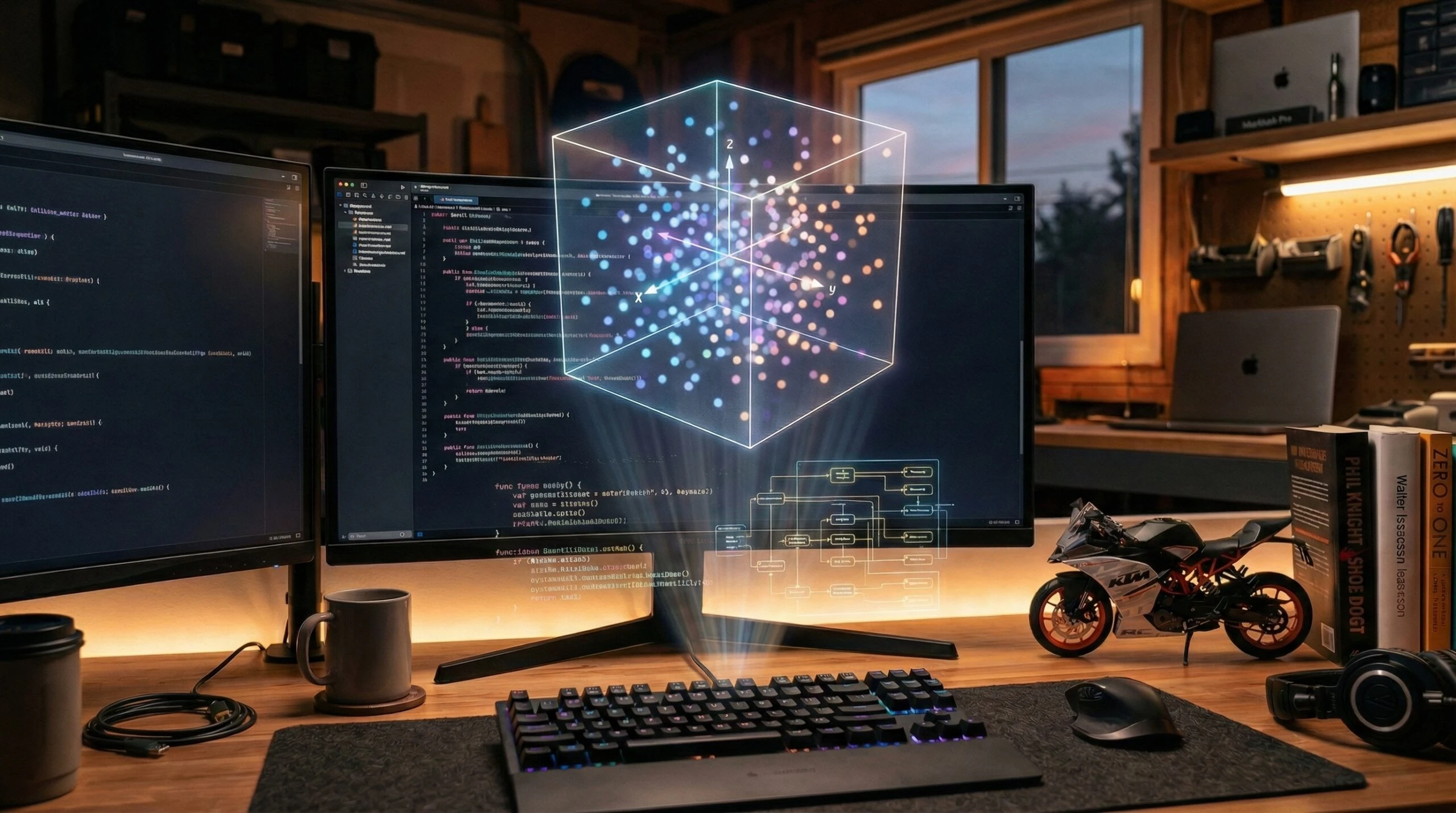
To overcome these hardware limitations, we need to rethink how we store and process information. My idea involves the transition of these values that cannot be stored exactly—meaning numbers like $0.3333…$—into spatial coordinates within a 3D Probability Cube. This is where the real answer to the “is coding dead” question lies: Code is not dying; it is becoming multi-dimensional.
By applying the logic of Quantum Computing, where a value can take any value between 0 and 1 at the same time, we can bypass the memory bottlenecks of modern hardware. Instead of forcing a number to be a specific bit, I think it will be much more efficient to store it by positioning it at any point within a spatial coordinate, because this time the computer will only keep its position in mind instead of trying to hold that value.
Generative Hallucinations: Daring to Dream
Actually, when you look at the title of this section, you might think I’m talking a bit of nonsense, but I think I can explain why I chose such a title. I believe the human brain also works in a structure somewhat resembling artificial intelligence. It has set certain rules for itself to sustain our normal daily life, because otherwise, we would have to go mad. Just as the only thing the human brain thinks about when it feels in danger is survival, I think this is the urge to protect mental health, which we can describe as healthy.
But I think if we can reduce the dosage of this protection a little, we can look more warmly at new ideas. One of the names who applied this idea much earlier with his own technique was Salvador Dalí. Salvador would try to fall asleep with an iron object in his hand. At that “hypnagogic” stage where he just falls asleep (that magical moment where consciousness is half-open and logic is disabled), his muscles relax, the object in his hand falls onto the tray with a noise, and he wakes up. At this moment, he writes down the first idea that comes to mind. In this way, an idea that seems absurd in a normal moment appears much more logical and somehow emerges.
My own personal motto has always been: “I can build anything whose architecture I can establish and plan in my mind.” In this new era, if you can visualize a system and plan its architecture, the tools to bring it to life are already at your fingertips. Therefore, my answer to the question of whether coding is dead is a big “no” for those who lead with their intelligence.
Final Thoughts on the Future of Development
In the conclusion, why did I explain such wide-ranging things? I gave these examples, which might seem strange, because I wanted to explain that coding is not dead but has changed shape, and how this new shape can be used efficiently.
But as a result, I would like to state now that the idea I mentioned above is currently at the idea stage. Since today’s computers do not work with the logic I mentioned, it does not seem very possible to implement for now. However, one must always continue to produce ideas and continue to talk nonsense.


 Veysel Okatan