
In my recently published article titled “M5 Ultra vs 5090” I examined my expectations regarding the M5 Ultra, as it was a model not yet introduced, and more specifically, a test Nvidia claimed to have conducted against the M3 Ultra. One of the most frequent comments on that piece was that the Mac Studio is not cheap, and for $10k, an A6000 could be purchased, making the Mac Studio choice seem illogical.
I have no interest in defending Apple, nor could I; I simply wanted to share my expectations. In this article, I want to explain how some commonly held beliefs might change with a new technology called 1.58 BitNet. I will do this using two products with very similar price points. On one side, a MacBook Pro with the new M5 Max technology, and on the other, the RTX 5090, whose price has reached a point significantly above its launch target.
The hardware we are basing this on: The 14-inch MacBook Pro from Apple’s official site with an M5 Max (18-core CPU, 40-core GPU), 64GB unified memory, and 2TB SSD, priced at $4,299. The RTX 5090 is currently circulating in the market between $3,800 and $4,200. With prices so close, I thought we could finally ask the question.
*Important: The RTX 5090 price reflects the GPU card only. A complete system (CPU, motherboard, RAM, PSU etc.) will add roughly $1,500-2,500+ depending on the build. The MacBook Pro M5 Max at $4,299 is a complete, ready-to-use system. This comparison focuses on the GPU vs. the laptop as standalone purchase decisions, not total system cost.
In recent months, I have seen the same question repeatedly on forums: “What should I buy for Local AI, an RTX 5090 or a Mac?” If you want to ask this correctly in 2026, we need to take one thing into account: BitNet b1.58.
Because BitNet is changing the rules of this comparison.
1. What is BitNet b1.58?
When you run a classic language model, the GPU is constantly doing the following in the background: take two decimal numbers, multiply, add, and continue. This is called “floating-point multiplication.” Models like LLaMA or GPT store every parameter in 16-bit (FP16 or BF16) precision, and every cell contains complex decimal numbers.
Microsoft Research’s paper published on February 27, 2024, asked: what happens if we remove this multiplication entirely? BitNet b1.58 restricts every weight of a neural network to only three values: -1, 0, or +1. Why “1.58 bit”? Because log(3) = 1.58, which is the amount of bits mathematically required to express three possibilities.
2. The Revolutionary Difference: Removing Multiplication
The most important point here is the difference in calculation at the hardware level:
- Standard models: When performing matrix multiplication, they multiply and add massive decimal numbers. However, multiplication is the part where a GPU consumes the most energy and works the hardest.
- BitNet b1.58: On this side, since the parameters are only -1, 0, and 1, there is no need for multiplication in matrix operations. Only addition and subtraction are performed.
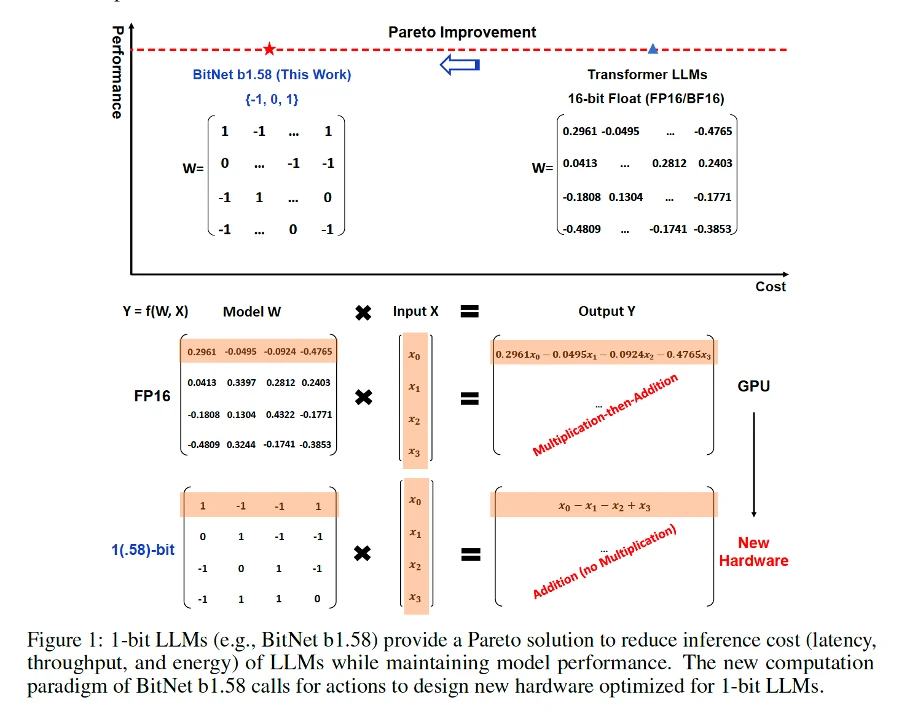
The paper also mentions the secret power of “0.” Original 1-bit models only had -1 and 1. The addition of “0” gave the model “feature filtering” capability. This significantly increases learning capacity by allowing certain information to be filtered out entirely.
3. What do the Numbers Say?
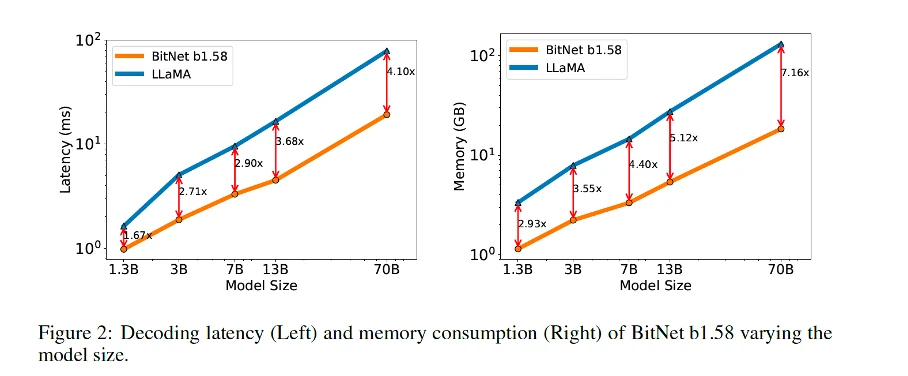
According to Microsoft’s own technical report, compared to a LLaMA model of the same size:
| Criterion | BitNet b1.58 70B | Against LLaMA FP16 |
| Speed | 4.1x faster | The gap widens as the model scales |
| Memory | 7.16x less | 70B model fits into much smaller GPUs |
| Throughput | 8.9x higher | More requests handled simultaneously |
| Energy (7nm) | 71.4x less | Arithmetic operation energy |
| End-to-End Energy | 41.2x less | 70B model, 512 tokens |
Critical point: BitNet b1.58 starts to match the performance of full-precision (FP16) models when it reaches the 3B size. This means it is both much cheaper and equally intelligent. And the scaling law table presented in the paper states:
- 13B BitNet b1.58 = Operates at the cost of a 3B FP16 model
- 30B BitNet b1.58 = Operates at the cost of a 7B FP16 model
- 70B BitNet b1.58 = Operates at the cost of a 13B FP16 model
4. So, What Do We Have Today?
Important note: The 70B benchmark data in the paper are academic tests conducted to show the real behavior of that model. At the time of writing, the largest native BitNet b1.58 ternary model available on Hugging Face remains 2.4B parameters (BitNet b1.58 2B4T). However, the broader 1-bit inference paradigm is moving faster than expected: PrismML independently released 1-bit Bonsai 8B on March 31, 2026 a fully 1-bit model running at 1.15GB, achieving ~40 tokens/sec on an iPhone 17 Pro. While Bonsai uses a different architecture than BitNet b1.58, it confirms that production-ready low-bit models at meaningful scale are no longer theoretical. The bitnet.cpp framework is still designed to support 100B models, and the ecosystem is growing rapidly. This difference between BitNet b1.58 specifically and the broader 1-bit movement should be kept in mind while reading
5. Back to Hardware: Technical Specifications
Official data for the configurations we are basing this on:
| MacBook Pro M5 Max (14″) | RTX 5090 | |
| Price | $4,299 | ~$3,800–4,200 |
| Memory | 64GB Unified Memory | 32GB GDDR7 |
| Bandwidth | 614 GB/s (Official Apple) | 1,792 GB/s (NVIDIA) |
| Power (Real) | ~50–130W (Depending on workload)* | 575W Card + System |
*In NotebookCheck’s measurement of the 16-inch M5 Pro, 134–147W was seen under maximum load. The 14-inch M5 Max is expected to stay below this during LLM inference.
6. Standard Models Table: NVIDIA in the Lead
In currently widely used models (Llama, Qwen, DeepSeek, etc.), the bandwidth difference is almost 3x: 1,792 GB/s vs 614 GB/s. Since token generation is directly proportional to bandwidth, this difference is reflected directly in the results.
For Llama 3.1 70B, Q4 quantization:
- RTX 5090: ~105 tokens/second
- M5 Max 64GB: ~85 tokens/second
Approximately a 20% difference. The gap widens for 7B–13B models, where the RTX 5090 is nearly 3x faster.
But there is a breaking point.
A 70B model with Q4 quantization takes up ~40–42GB. The RTX 5090’s 32GB VRAM is not enough; part of the model is offloaded to system RAM, and the speed drops dramatically. I believe those who commented on my previous post will understand this. The M5 Max’s 64GB unified memory can handle this model without issues. If you move to a 128GB configuration, 100B+ models also become possible.
7. What Changes When BitNet Steps In?
All the comparisons above apply to standard FP16/Q4 models. For models running on the BitNet b1.58 architecture, the game changes.
- NVIDIA’s Problem: The RTX 5090’s Blackwell architecture contains thousands of CUDA cores optimized for FP4 and INT8 operations. However, in BitNet, there is no multiplication only addition. When such simple math is involved, a large portion of those cores remain idle.
- Apple’s Advantage: In BitNet, the main bottleneck is no longer computing power but memory bandwidth. The real advantage comes from the M5 Max’s unified memory architecture, where the CPU and GPU share the same memory pool. There is no cost for moving data over PCIe. Microsoft’s official inference framework, bitnet.cpp, provides a 1.37x to 5.07x speed increase on ARM, while on x86, it is 2.37x to 6.17x.
The paper itself predicts this: “We envision and call for actions to design new hardware and system specifically optimized for 1-bit LLMs.” In other words, even academics say the current GPU architecture is suboptimal for this task.
8. Future Vision
Three areas discussed in the paper are particularly important:
- Mobile and Edge Devices: Thanks to low memory and energy consumption, running massive models on a phone or laptop is no longer a dream. Apple’s unified memory architecture is structurally more ready for this transition.
- Long Context: Since BitNet also drops activations from 16-bit to 8-bit, you can process twice as much text with the same memory capacity.
- New Hardware: Although current GPUs are designed for decimal numbers, the paper suggests that new chips focused solely on 1.58-bit addition logic should be designed. This is exactly the direction in which Apple’s unified memory + Neural Engine architecture is moving.
9. If You Are Going to Train, the Discussion is Closed
If you have a fine-tuning or training workflow, the RTX 5090 wins hands down.
The entire training ecosystem PyTorch CUDA, bitsandbytes, Flash Attention, DeepSpeed is written for NVIDIA. Apple’s MLX framework supports some LoRA scenarios, but distributed training, mixed-precision training, and image model training are entirely exclusive to NVIDIA. Since they lead the industry, it does not surprise me that most software is Nvidia-specific.
Summary Table
| RTX 5090 | MacBook Pro M5 Max 64GB | |
| Price | ~$3,800–4,200 | $4,299 |
| Memory | 32GB GDDR7 | 64GB Unified |
| Bandwidth | 1,792 GB/s | 614 GB/s |
| 7–32B Model Speed | ~3x faster | – |
| 70B+ Model | Fits partially | Runs smoothly |
| Power (Real) | 575W Card + System | ~50–130W |
| Training | Wins hands down | Limited |
| BitNet Scenario | Idle cores | Efficient architecture |
Conclusion
The RTX 5090 is still significantly faster for models below the 32GB limit. This is a fact.
But the table is not always this one-sided. When the model size increases, the VRAM wall emerges. The power consumption difference is serious. And as architectures like BitNet b1.58 mature, hardware built on the question of “who can multiply more” may lose popularity.
Microsoft’s own paper says new hardware must be designed. Until that new hardware arrives, the most ready architecture for BitNet among current options is the unified memory and ARM-based one. The M5 Max seems more ready for this transition. However, large native ternary models are not yet available, and it is uncertain when this transition will be complete. Until then, for those with small-to-medium model sizes and training needs, the RTX 5090 remains a strong option.
Sources
Official Technical Documents
- MacBook Pro Tech Specs – Apple.com
- Apple debuts M5 Pro and M5 Max – Apple Newsroom
- Apple M5 – Wikipedia
BitNet Technical Resources
- The Era of 1-bit LLMs: All Large Language Models are in 1.58 Bits – arXiv
- BitNet b1.58 2B4T Technical Report – arXiv
- microsoft/BitNet – GitHub


 Veysel Okatan