Note: This article was based on predictions made before GTC Taipei 2026. The real announcements are now out. For a full breakdown of everything Jensen Huang officially revealed, check out our GTC Taipei 2026 keynote recap: GTC Taipei 2026 Keynote: N1X and Everything Announced
For a long time, the laptop market was a two-horse race between Intel and AMD, with Apple occasionally shaking things up. But spring 2026 is something else entirely. Apple just dropped its M5, and NVIDIA is about to respond at GTC 2026 with something it has been quietly building for years: the N1X, an ARM-based chip developed with MediaTek. I’ve been following this closely, and I want to share what I think is actually happening here. Here’s the NVIDIA N1X vs Apple M5 comparison.
For the Apple side of this equation, I’ve also covered what to expect at WWDC 2026 on June 8th, including M5 Ultra, Siri 2.0, and iPhone Fold. Read here →
What is the Apple M5 actually offering?
When I look at the M5 Pro and M5 Max chips, Apple is doing what it always does: pushing its own architecture as far as it will go. The M5 Pro has an 18-core CPU and 20-core GPU. The M5 Max takes it further with the same 18-core CPU but up to 40 GPU cores. Both chips share something that genuinely surprised me: a Neural Accelerator embedded inside every single GPU core. Apple claims this makes AI compute performance four times higher than M4. That is not a small number.
The performance results back this up. In Geekbench 6, the M5 achieved a single-core score of 4,263. No Mac or PC processor has matched that yet. Battery life on the 16-inch model goes up to 24 hours. These are impressive numbers by any standard.
But then you look at the price. The 14-inch M5 Pro starts at $2,199. The M5 Max starts at $3,599. Apple has always played in the premium segment, and that is not changing anytime soon.
So what is NVIDIA actually building?
NVIDIA is not just a GPU company anymore, and the N1X makes that very clear. This is a full System on a Chip with a 20-core ARM CPU built around Cortex-X925 cores. Leaked Geekbench scores show 3,096 in single-core and 18,837 in multi-core. Single-core is behind Apple, but multi-core is competitive.
What makes this interesting is the GPU inside: Blackwell architecture with 6,144 CUDA cores. That is roughly equivalent to a desktop RTX 5070. On a laptop chip. The CUDA ecosystem is also something Apple simply cannot match right now. The vast majority of AI software is optimized for CUDA first, everything else second.
Where things get really interesting: Gaming
This is the part I care about most. Running x86 Windows games on ARM has always been painful because of emulation overhead. NVIDIA’s answer to this is reportedly DLSS 5.0 running entirely on the N1X’s Neural Processing Unit. Apple’s NPU is not fast enough for frame generation, so the GPU has to handle upscaling. NVIDIA is expected to offload this completely to the NPU, which would mean even if the CPU is translating x86 instructions, the frame generation keeps running smoothly. We won’t know how well this works in practice until real devices ship.
Microsoft is also releasing a version of Windows 11 called Bromine, specifically optimized for next-generation ARM chips like the N1X. Dell and Lenovo are reportedly preparing N1X laptops in the XPS, Alienware, Legion, and Yoga lines.
Update: May 2026 – What’s Changed Since This Article
Things have moved fast. Lenovo’s internal systems recently referenced the “Nvidia N1X Portal” twice, which confirms they are actively developing N1X-powered laptops. Dell is reportedly doing the same with multiple SKUs including XPS and Alienware lines.
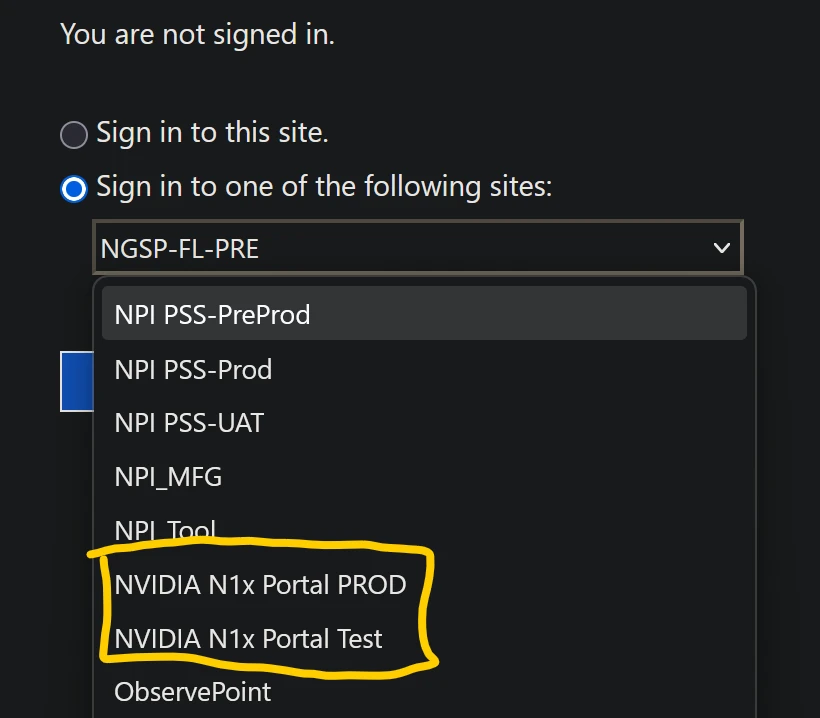
Lenovo’s ADFS website
The big date is Computex 2026, running June 2-5. Nvidia is widely expected to officially unveil the N1X there. If it doesn’t happen at Computex, the chip may never realistically compete, since further delays would put it up against Qualcomm’s Snapdragon X2 Elite Extreme and Apple’s M5 Pro at an increasingly disadvantageous position.
One thing worth noting: the N1X has already been delayed at least once due to software compatibility issues. The hardware looks compelling on paper, but software readiness is still the open question.We are actively discussing how NVIDIA N1X will stack up against AMD Ryzen AI Max and Snapdragon C at Computex 2026 on our forum. Join the community discussion here to see who actually wins the ARM laptop war.
So the core argument of this article holds. Apple’s M5 remains the mature, proven choice right now. The N1X is the most interesting challenger we’ve seen in years, but it still has to ship.
Update: May 31, 2026 – Dell XPS
Things moved fast. Dell has officially confirmed an XPS laptop powered by the NVIDIA N1X, set to launch at Computex 2026. The embargo lifted today. This is no longer a rumor.
The N1X specs are now essentially confirmed: 20 ARM cores, 6144 CUDA cores based on Blackwell architecture. It is essentially a GB10 Superchip optimized for laptops, with full Windows support unlike the DGX Spark before it.
Lenovo was already confirmed. Now Dell is in too, with an XPS laptop officially on the way. MSI is also reportedly preparing N1X-based systems, though nothing official yet. NVIDIA is officially entering the consumer SoC market, and the XPS branding makes clear this is a mainstream product, not a workstation.
Jensen Huang’s keynote is scheduled for June 1, 2026 at 11:00 AM Taiwan time (UTC+8). That is when the full picture becomes clear.
The core argument of this article still stands: Apple M5 is the proven choice right now. But for the first time, it has real competition on the Windows side at the chip level.
Who actually wins?
Honestly, it depends on what you need. Apple’s M5 is the better choice if you are a professional creator, if you live in the Apple ecosystem, or if single-core speed matters most to you. It is a refined, mature platform and it is not going anywhere.
But if you want a Windows laptop with MacBook-level thinness and battery life while still being able to game and run CUDA-based AI workloads, the N1X is the first real answer to that. NVIDIA has been dominant in data centers and GPUs for years. Bringing that directly to a consumer laptop chip is a significant move.
I am genuinely curious to see the first real-world N1X devices. The specs on paper are one thing. How it actually performs in daily use is another. But for the first time in a while, Apple has real competition at the chip level, and that is good for everyone.

 Veysel Okatan