Hey everyone.
This is going to be a long one, but it’s worth it because Jensen Huang took the stage and redesigned the world in about two hours. I’m not exaggerating. The GTC Taipei 2026 keynote wasn’t just a GPU launch; it was a manifesto. They covered every layer, from agentic AI infrastructure to your desktop, from autonomous driving to humanoid robots. We were making predictions before, and now I want to give you a solid breakdown of what actually happened.
Let’s go through it from the top.
1. Infrastructure: The Gigawatt Problem and DSX
Jensen opened with infrastructure. Why? Because AI factories are now consuming power at the gigawatt scale, and at that point the “set up a server and plug it in” mindset simply falls apart.
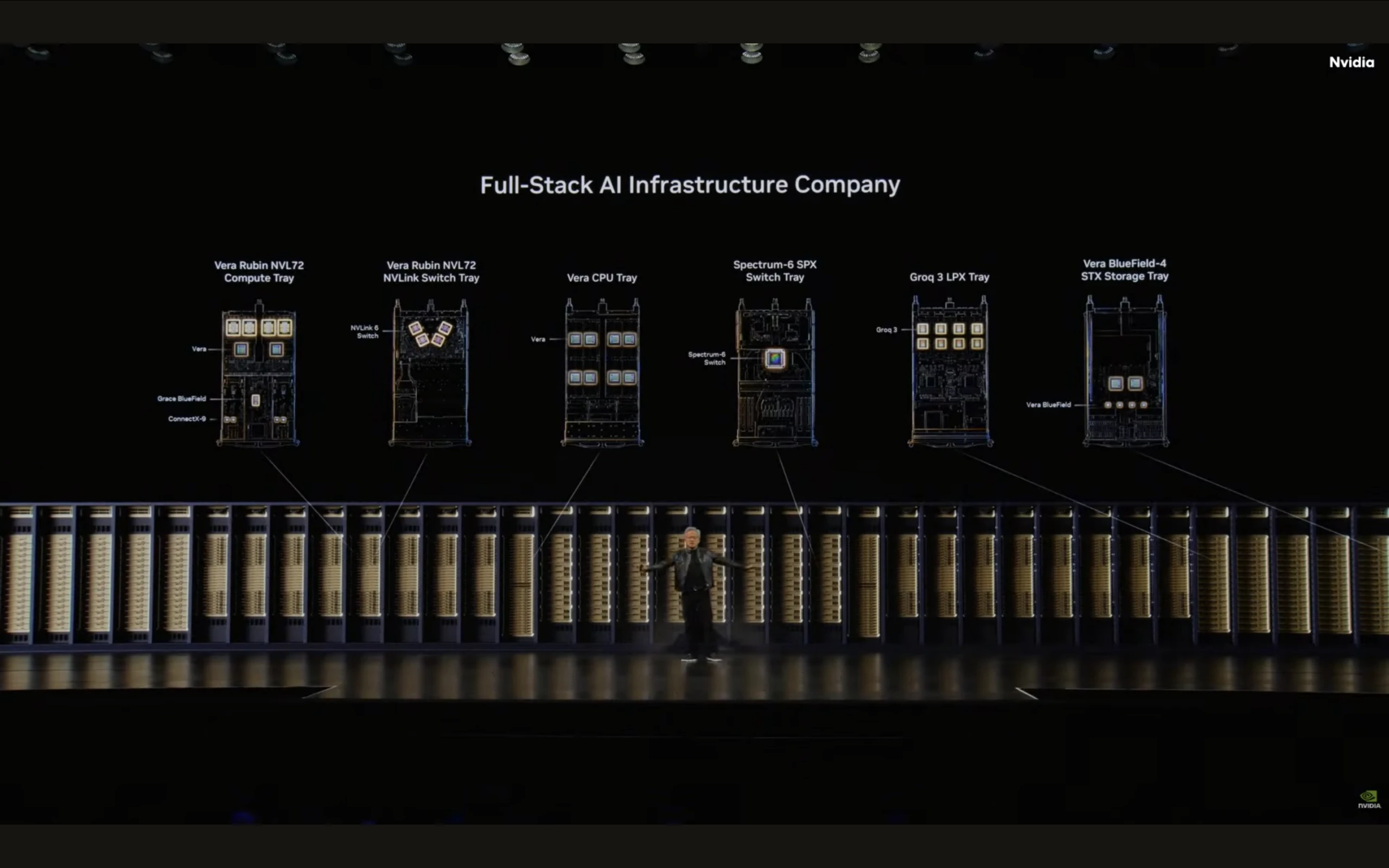
NVIDIA’s answer is the DSX infrastructure. It has three parts:
- DSX Sim: Simulates the entire data center as a digital twin before a single physical server is installed. Network topology, power distribution, cooling, all of it gets tested virtually first. Then you build the real thing.
- DSX OSS: Makes the infrastructure multi-tenant and automates operations.
- DSX Max LPS: Dynamically routes idle watts to the racks with heavy workloads. Result: 40% more GPUs on the same budget.
Think about that last point. Same budget, 40% more GPUs. For anyone running a data center, that number means a serious transformation.
2. Vera Rubin: The Supercomputer for the Agentic Era
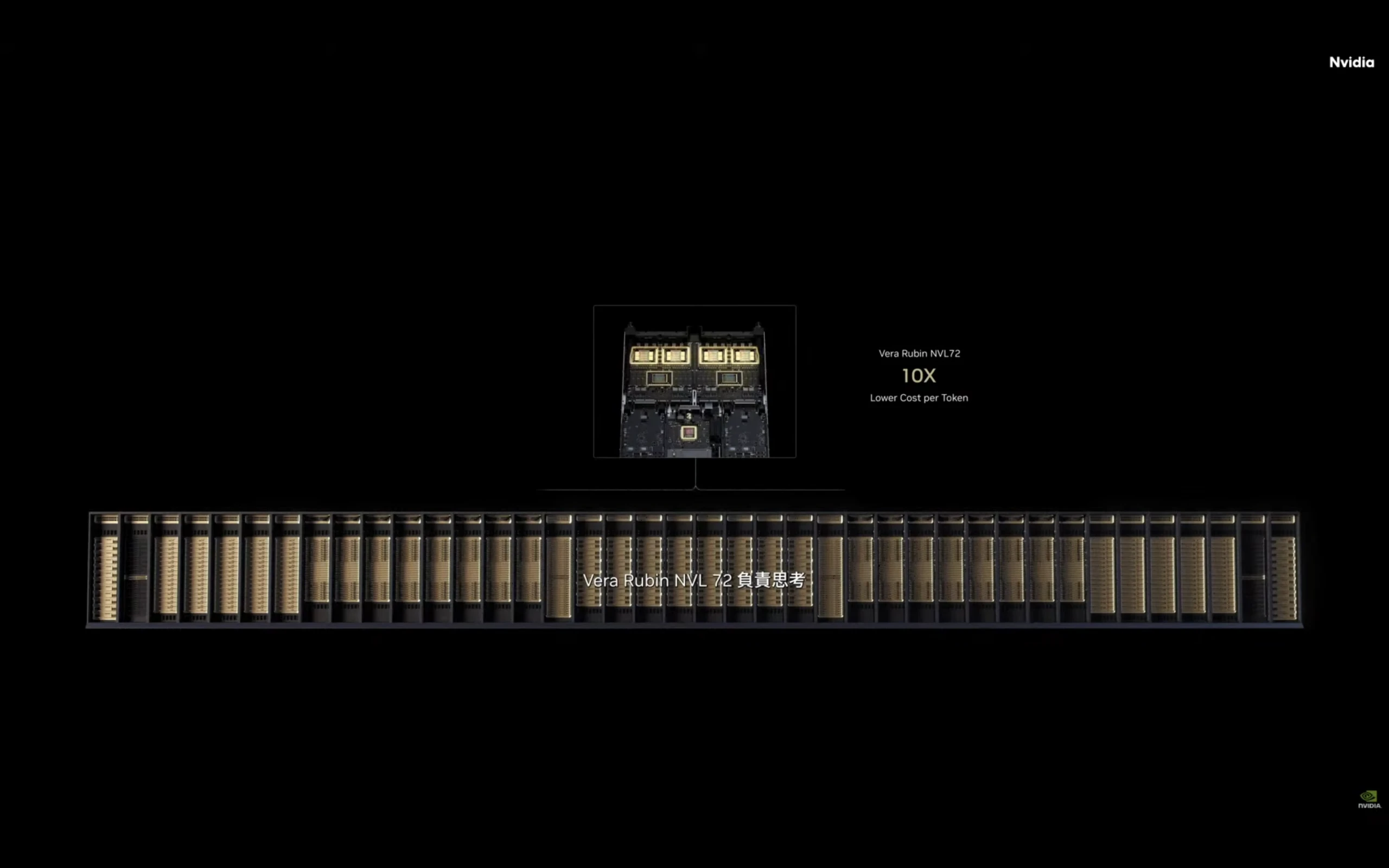
Up until now, AI chips were mostly optimized for generative workloads. Vera Rubin is designed for the shift to the agentic era. What’s the difference? Agents don’t just generate text. They use tools, make plans, run code, make decisions. That workload demands a very different latency and bandwidth profile.
The system is built from 7 new chips, manufactured on TSMC’s 3nm process, backed by HBM4 memory. But the thing that caught my attention most: Vera Rubin NVL72 cuts the cost per token by 10x. When Jensen said that number, the room went noticeably quiet. Fair enough, because in terms of pricing, that changes everything.
3. NVIDIA Vera CPU: Rewriting the Processor from Scratch
Alright, we’re going a bit deep here but I promise I’ll keep it understandable.
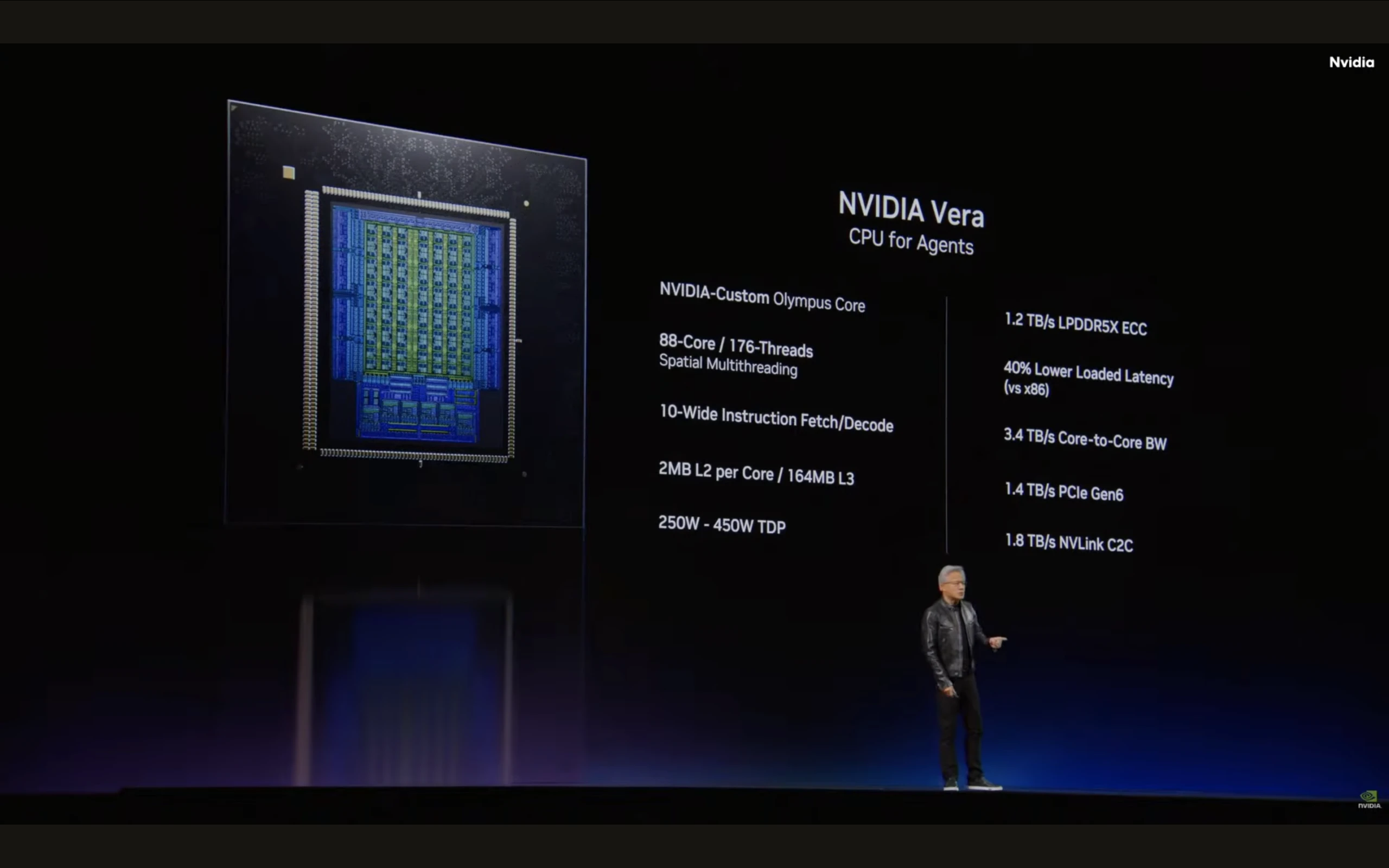
NVIDIA is basically saying: we humans are too slow now, AI agents are much faster, and we need to build something for them. That something is a brand new architecture called Olympus.
Why a new architecture? Because x86 is optimized for traditional virtualized/multi-core human renting workloads. So single-threaded performance is critical, and x86 is genuinely weak at that.
What does Vera do?
- 88 Olympus cores unified on a monolithic die, specifically to eliminate latency
- 10-wide instruction fetch and decode
- 1.2 TB/s LPDDR5X memory bandwidth
- 40% lower loaded latency compared to x86
- 1.8x to 3x improvement in agent code execution and SQL query performance versus conventional processors
“Built for agents racing in nanoseconds, not seconds,” Jensen said. Does that sound a bit dramatic? Maybe. But the numbers are real.
4. The Software Side: NVIDIA Agent Toolkit
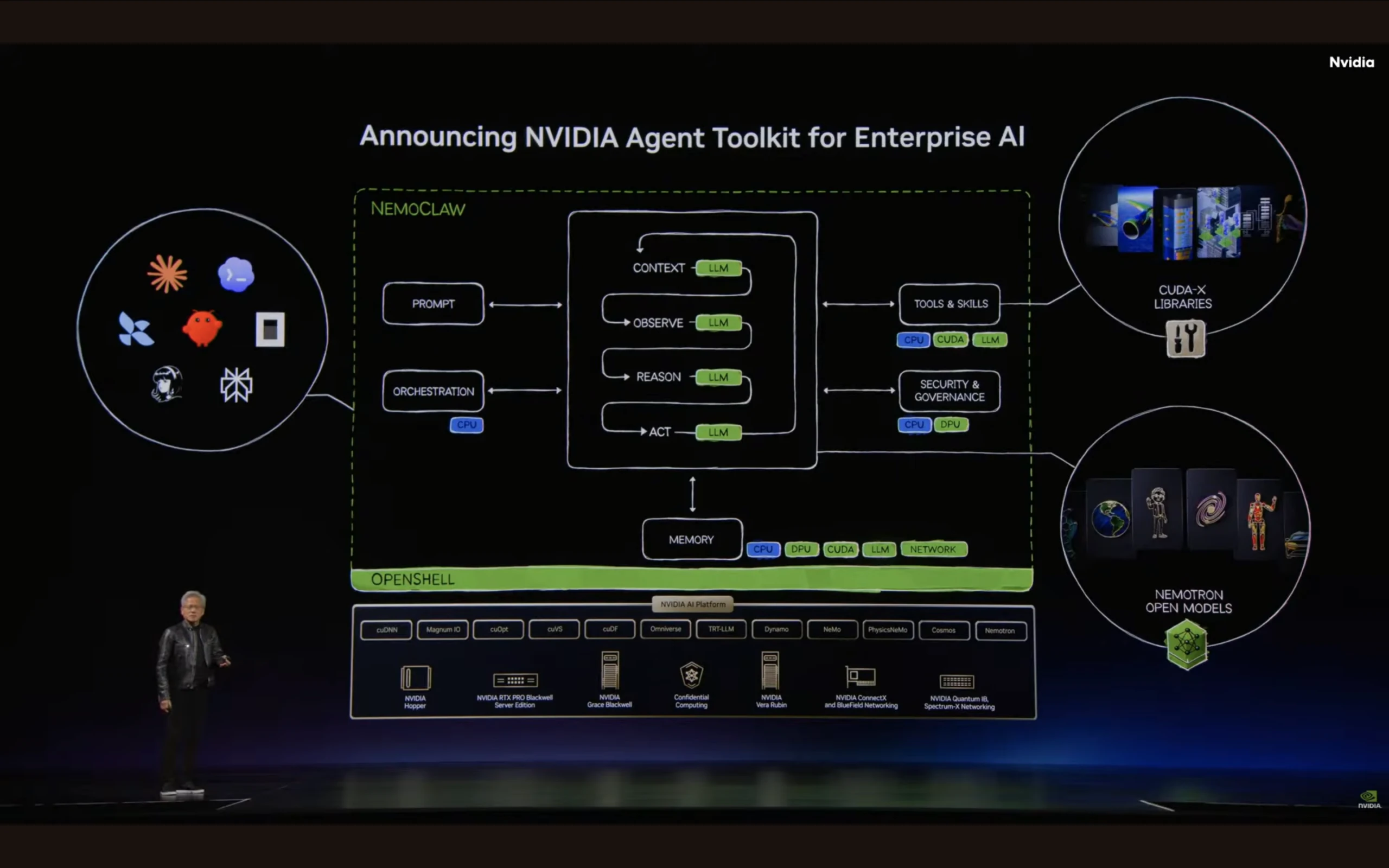
Hardware alone isn’t enough. Companies need a proper runtime environment to build their own agent ecosystems. That’s exactly what Agent Toolkit solves.
The system brings together a model, an orchestration layer, a skill set for agents to use, and a security mechanism. OpenShell is particularly interesting: it’s an open-source sandbox that confines agents within corporate security policies. It restricts their permissions and protects privacy. Security is genuinely top-tier with this setup.
What does that look like in practice? Jensen showed a demo where agents integrated with EDA tools like Cadence brought chip validation tests that used to take weeks down to hours. If there’s anyone reading this who works in chip design, I’m genuinely curious what they felt hearing that.
5. Nemotron 3 Ultra: Open Models Are in the Game
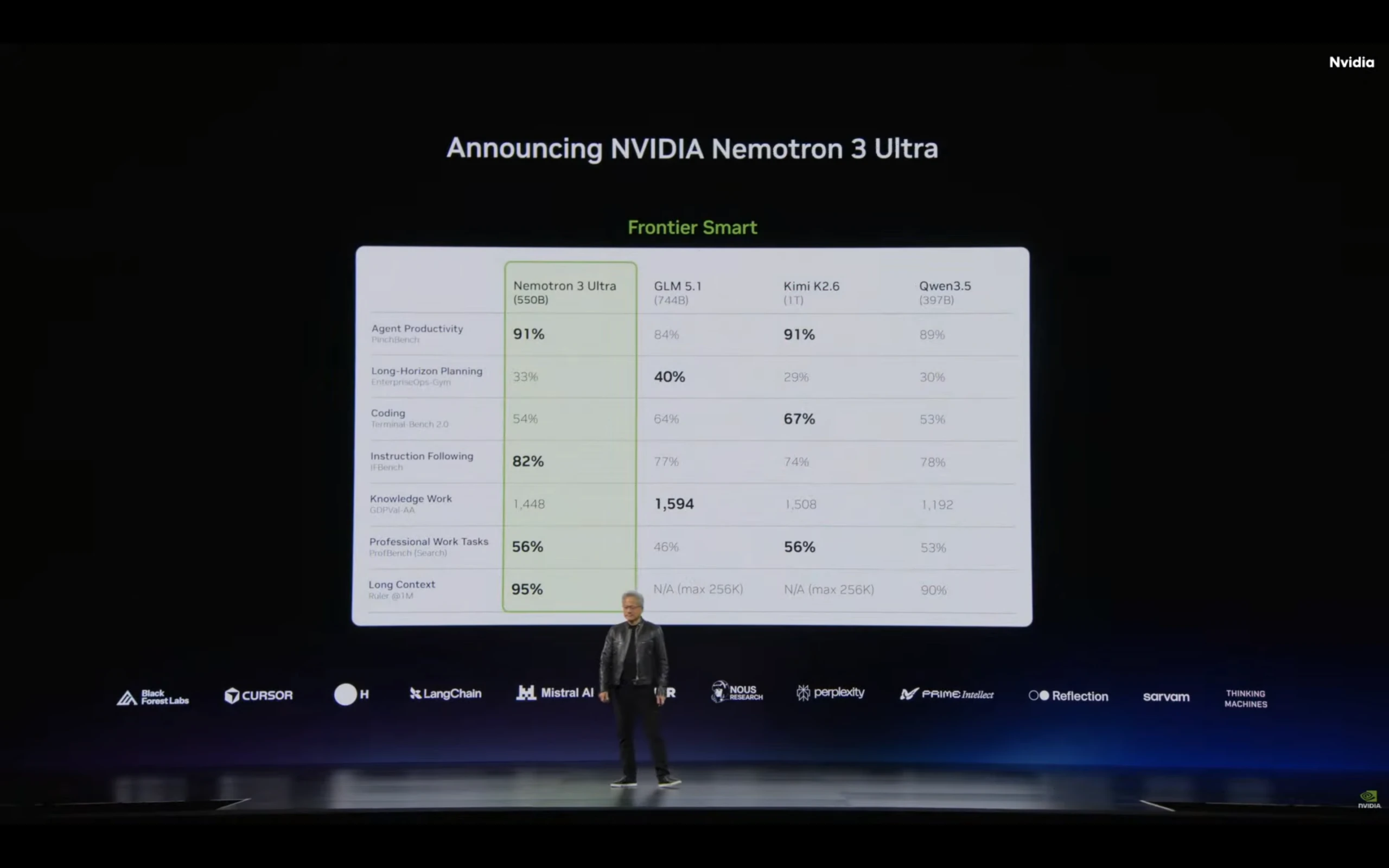
NVIDIA’s major play on the open-source model side comes in the form of Nemotron 3 Ultra. And this isn’t just a marketing announcement; the architectural numbers do the talking.
The standard Transformer architecture has a massive scaling problem, since as the token count grows, memory consumption increases quadratically. Nemotron 3 Ultra tackles this head-on by utilizing a hybrid State Space Model (SSM) and Mixture of Experts (MoE) architecture.
The structural payoff is huge. Nemotron 3 Ultra delivers its performance while using 30 percent less compute and running 5x faster than conventional open-source models. Its efficiency in handling long context windows and executing complex instructions makes it a massive milestone for the open model ecosystem. For developers, this means the barrier to deploying highly capable, low-latency agents has just been significantly lowered.
6. RTX Spark and N1X: Putting a Data Center on Your Desk
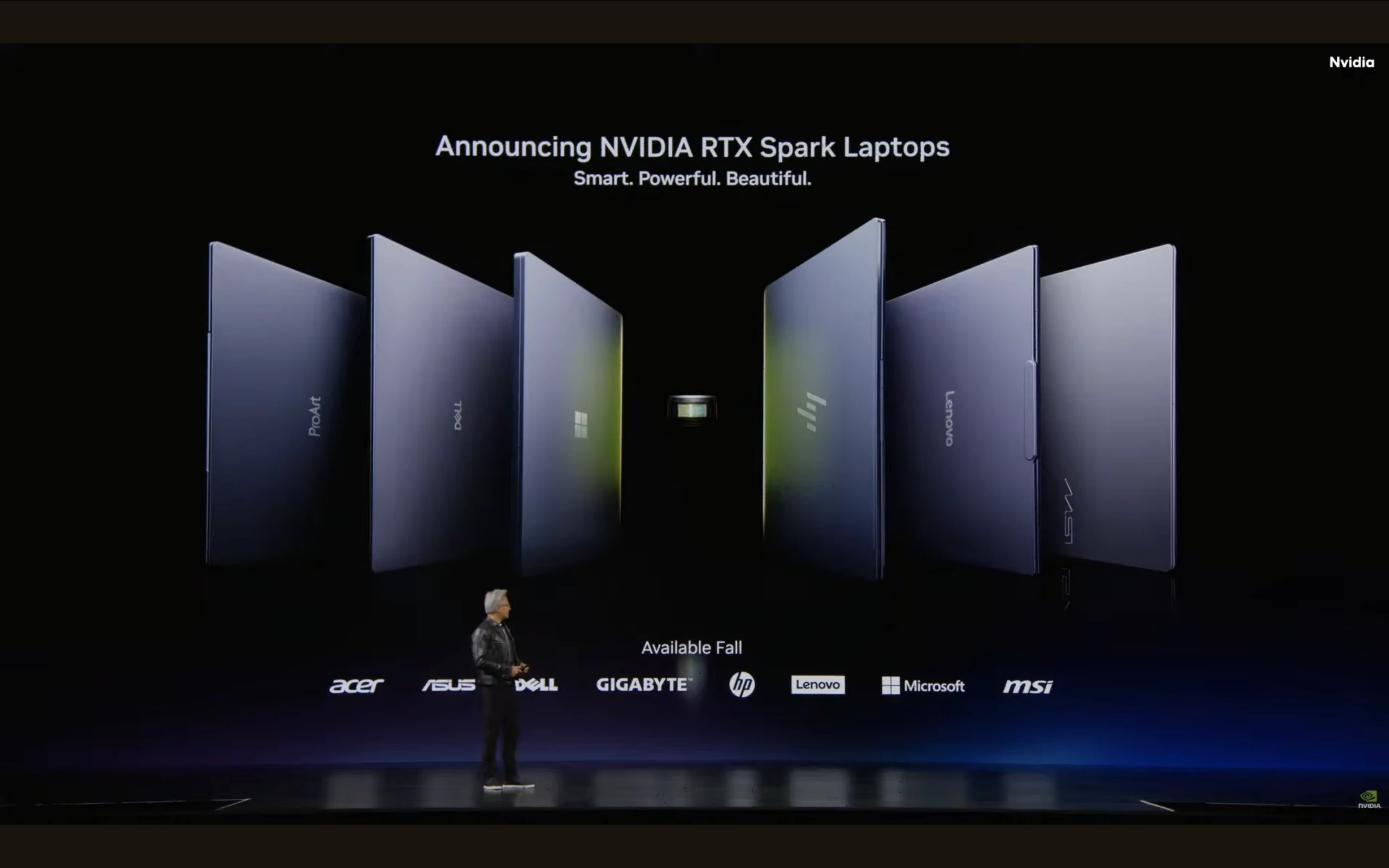
Now we get to the section that’s going to get the most attention.
NVIDIA announced the RTX Spark platform in partnership with Microsoft and MediaTek. And this isn’t a new GPU generation. They’re rewriting Windows at the architectural level, 40 years later.
At the heart of it is the N1X chip. Why does this chip matter?
Because this is the first system that can run NVIDIA’s 33 years of software, CUDA, TensorRT, graphics libraries, bioinformatics tools, astrophysics simulations, all of it, on a single SoC. Without a cloud connection, offline, locally.
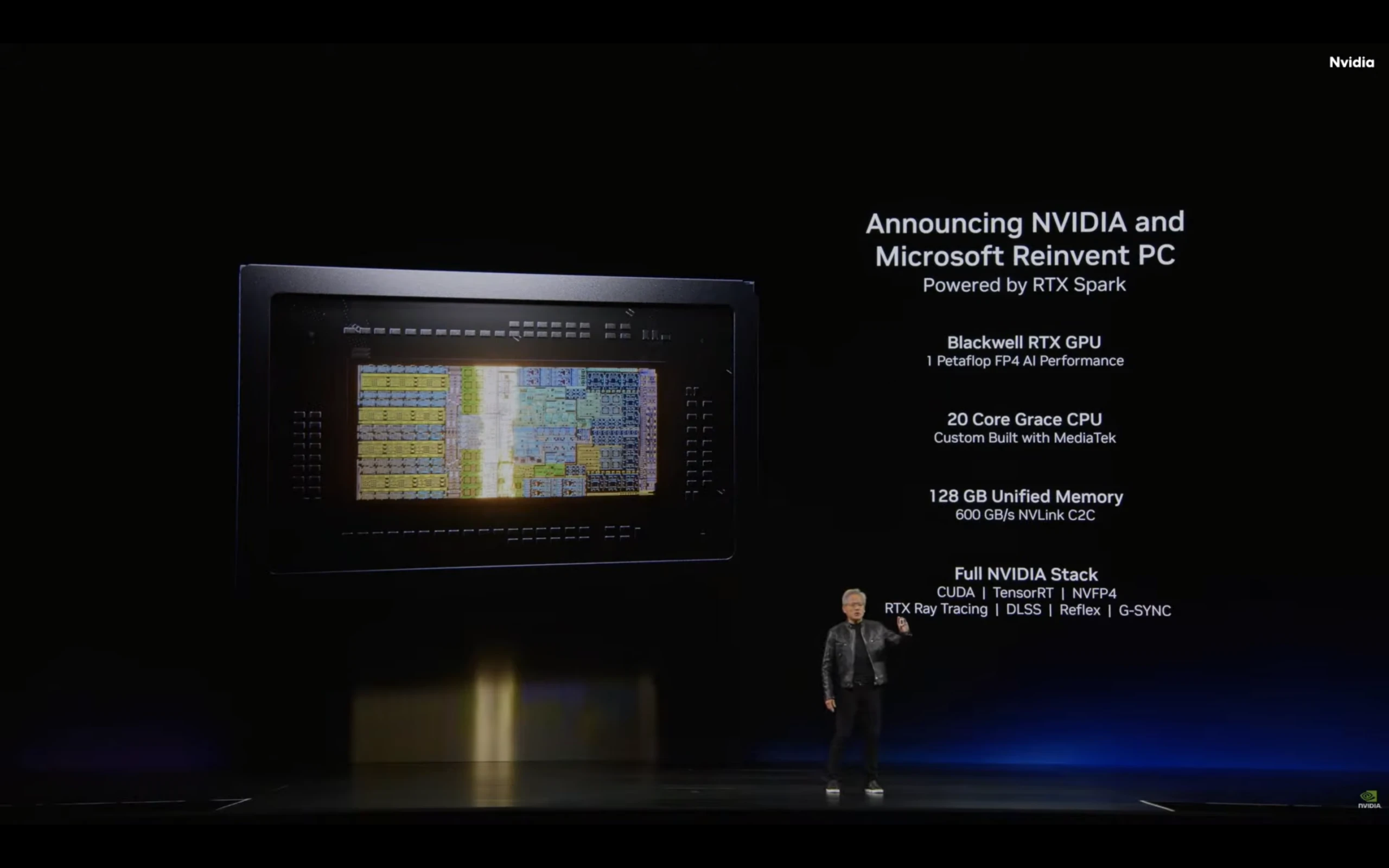
The specs
Laptop versions are coming this fall: Acer, ASUS, Dell, Gigabyte, HP, Lenovo, Microsoft Surface, and MSI. Desktop workstation versions are also coming, designed to run 24/7.
I have to ask: a laptop with 128 GB unified memory and 1 PetaFLOPS of AI performance. Most of the things you currently need to hit a cloud API for will run locally on this machine. That genuinely excites me.
And what really gets me going: can this finally go head to head against Apple’s M-series, which has been dominating the performance-per-watt conversation for years now?
7. Physical AI: Cosmos 3 and Robotics
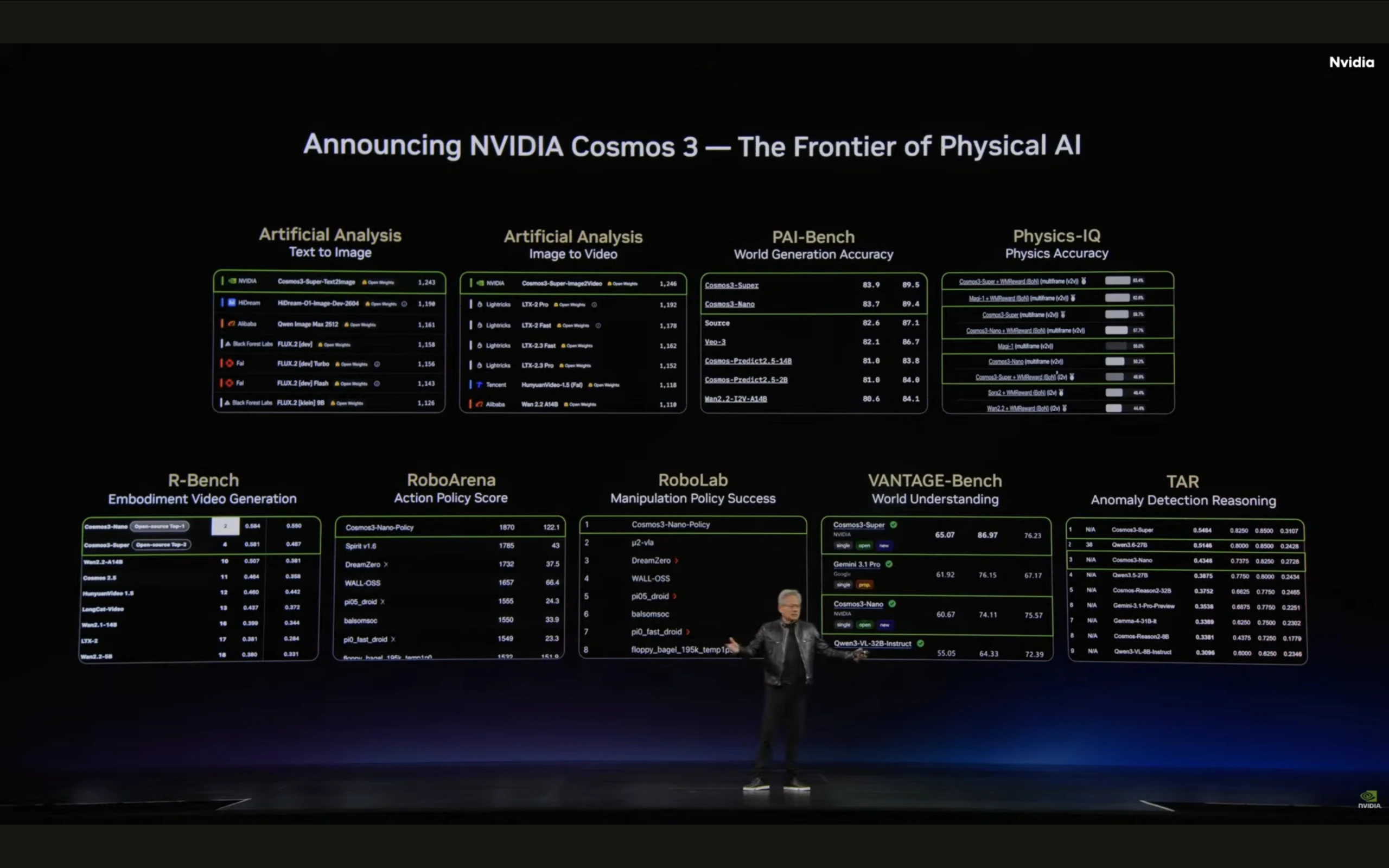
The challenge of getting AI out of the digital world and into the physical one is probably the hardest part of the whole keynote. Because the biggest problem with physical AI is data scarcity. Teaching a robot how to move its arm requires millions of data points. Collecting that data from the real world takes years.
NVIDIA’s answer is Cosmos 3. The core idea: compute is data. Convert computing power into data. Cosmos 3 generates physics-accurate synthetic video and scenarios inside Omniverse. You train your robot through thousands of virtual scenarios, then transfer those algorithms to the physical robot. Honestly, I think this is insane in the best way.
Looking at the benchmarks, PAI-Bench World Generation Accuracy sits in the 83.7 to 89.5 range, and on Physics-IQ it leaves competitors well behind. The numbers are great, and the real point is this: this technology will fundamentally change the training pipeline for everything from autonomous vehicles to surgical robots.
Alpamo 2 was also introduced here, a reasoning architecture for autonomous driving. It continuously processes vehicle camera data and builds real-time decision trees. A live demo was shown on a Mercedes on stage, with the car thinking out loud as it made traffic decisions. “The shift from perception to reasoning,” Jensen said. That line was one of the most important of the entire keynote in my opinion.
8. Isaac Groot: An Open-Source Answer to Boston Dynamics
NVIDIA’s humanoid robotics move: the Isaac Groot platform and its accompanying reference robot.
Height: 6 feet. Weight: 150 lbs. 25 degrees of freedom in each hand, 31 in the torso. Running on the Jetson Thor architecture.
But the real message isn’t the hardware. It’s the software: you do motion capture and simulation training inside Omniverse, then push the algorithms directly to the physical robot. A lab no longer needs to worry about mechanical design. It can focus entirely on software and agent development.
Boston Dynamics has dominated most of this market until now. An open-source reference stack could change that.
Final Thoughts
That’s the summary of a two-hour keynote. But I want to say this: these announcements aren’t independent products. They’re all pieces of the same story.
The big picture Jensen painted: AI is no longer just a tool that generates text. It’s a system that uses tools, makes plans, and interacts with the physical world. And NVIDIA is trying to build every layer of that system, from the chip to the operating system, from software tools to desktop hardware.
After this keynote, calling NVIDIA just a GPU company doesn’t really hold up anymore.


 Veysel Okatan