In these days when the traditional era of “Googling” is on the verge of ending, a new concept is emerging: the “Agentic Era.” We can call it our new assistant. In fact, I can say it is one of the two reasons that put an end to the concept of “Googling.” These two reasons can be explained as a cycle of each other.
1- The serious decrease in people’s attention spans; for example, many people will be performing the phenomenon we call “fast scanning” while reading these lines instead of actually reading them. 2- The fact that the assistant assistants we call the “Agentic Era” are very advanced; so this has become a cycle: as agents developed, focus spans shortened. Now, let’s examine in more detail why Googling is dying.
2. Why is “Search” (Google it) Dying?
We are in a period where the traditional search engine model is labeled as “slow” and “inefficient.” It wouldn’t be wrong to say that a large part of the internet has now turned into a landfill; what I mean by garbage here is not what artificial intelligence produces, but the unnecessary and “clickbait” meaning lie content that people produce themselves. For this reason, people no longer want to “Google it.”
The Zero-Click Crisis: More than 70% of mobile searches no longer result in a click to any website; users get their answers directly within the interface.
Traffic Loss: Publishers have lost 40% of their web traffic due to “AI Overviews.” Services such as AI search, which Google has recently started to offer, have brought this about.
Gartner’s Prediction: Gartner’s prediction of a 25% drop in traditional search volume due to AI agents has now become a reality.
Another thought of mine that kills “Googling” is advertisements. In fact, advertisements are the income of many content creators, including myself, but advertisements have long passed the point of being controllable. People see so many ads in a day that this situation has become far from sustainable for both the buyer and the advertiser. We will all see together what will happen in the new era and what position advertisers and buyers will be in.
2. Siri 2.0 and macOS 17: Your Mac’s Co-Pilot Transformation
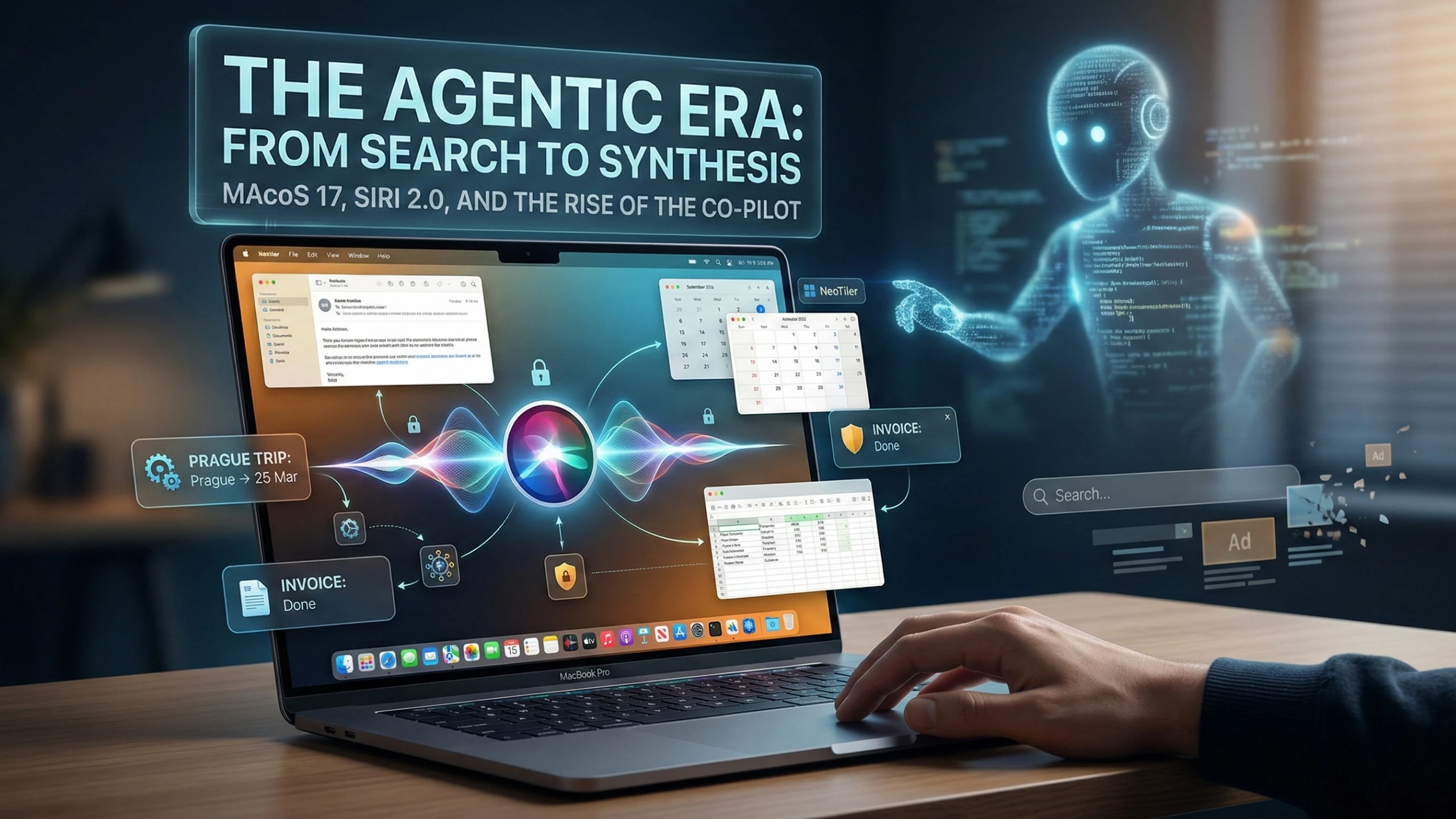
In the new era, your Mac is no longer just a computer; it is becoming an assistant that manages complex tasks on your behalf. Siri, which is expected to be introduced with iOS 27, is expected to become much smarter thanks to the collaboration with Gemini.
Instead of an old Siri that doesn’t remember any past, we expect a Siri that has a context window and remembers the past. And with this, perhaps our need to enter the internet may decrease to very low levels.
Cross-App Actions
Thanks to Apple’s App Intents framework, AI agents can jump into apps, click buttons, and transfer data. This means we now have a real assistant.
My Developer Perspective
My priority has always been ease of use and efficiency. I believe these new features will be a huge benefit for those aiming for maximum usability. Apple opening up this system offers a massive opportunity for those of us wanting to optimize the user experience.
3. The “Agentic Era”: Who’s in Control?
At this point where AI can make independent plans to reach goals—which sometimes surprises me by doing extra things I didn’t ask for—privacy and security become very important.
Assistant or Decision Maker?
I think agents shouldn’t make decisions for us; because I don’t believe they have that strategic cognitive depth yet. They should remain as co-pilots that flawlessly execute our commands.
The Privacy Paradox
While Apple promises to process data without storing it in the cloud via Private Cloud Compute (PCC), I would personally hesitate to trust anyone’s word on this. Regarding Siri now being able to see our screens, I frankly remain cautious about our screens being constantly monitored.
Conclusion: From Operator to Strategic Director
In 2026, 42% of businesses have integrated AI agents into their operational processes. In this new world, our role is evolving from simple “operators” to “strategic directors” managing the process. I believe it is an inevitable reality that the industry will shift toward a more practical and result-oriented direction where people no longer want to deal with the friction of manual tasks. However, in such a fast-developing technology, our position is changing very quickly; I conclude by saying that I think it is useful to know this as well.

 Veysel Okatan